About the Genealogica project
A collaborative database of Romania's historical population
Why Genealogica?
Genealogica began from a very concrete personal need: to systematize the information gathered during research into my own genealogy. As documents accumulated, it became increasingly clear that the problem was not the lack of sources, but the lack of a coherent framework in which this data could be organized, correlated, and understood as a whole.
This direct experience revealed a broader frustration, common to many genealogy enthusiasts in Romania. Although documents exist in archives, they are difficult to access, dispersed, and rarely indexed by name. At the same time, other communities and ethnic groups have succeeded, through sustained efforts, in building solid genealogical research tools and systematically digitizing essential sources.
A commonly encountered prejudice persists: that Romanians "didn't keep their records" and that a family tree cannot be built beyond grandparents or great-grandparents. Archival research frequently contradicts this perception. There is a considerable amount of documents that record the population by name, sometimes with a surprising level of detail, but which remain little known and difficult to explore without serious paleographic knowledge.
In this context, Genealogica emerged as a response to a real need, initially personal, later assumed at the collective level. The project starts from the premise that genealogical study in the Romanian space is not only possible, but also legitimate and relevant from a historical and methodological point of view. Genealogy is not reserved for "distinguished" families or exceptional cases, nor does it represent an exercise in vanity. On the contrary, it offers a framework through which local, family, and community histories can be documented, analyzed, and correlated at the micro level.


What we aim for
The main objective of the Genealogica project is to build and develop the most comprehensive genealogical and demographic database of Romania's historical population, starting exclusively from primary documents. Our vision is to create an essential tool for anyone who wants to compile a documentarily validated family tree. We do not seek to offer prefabricated conclusions, but to provide a coherent framework in which data can be analyzed, correlated, and interpreted responsibly.
In the long term, the project aims at the systematic transcription and indexing of nominal archival documents, the correlation of people with localities, sources and events in which they appear, as well as facilitating genealogical, historical, and demographic research.
Equally, Genealogica aims to create a collaborative framework in which individual work, often invisible, contributes to a collective, lasting result.
What you find on Genealogica.ro
The Genealogica platform is designed as a working tool, not as a finished product or a closed catalog. Information is built gradually, as documents are transcribed, verified, and related to each other.
On Genealogica you can search for real people, documented through records, from different historical periods, you can track their appearances in distinct sources and you can understand the context in which they lived. Each piece of information is accompanied by an explicit reference to the source from which it comes, so that the researcher can evaluate the value and relevance of the data themselves.
The page dedicated to localities functions as a central point for archival information. For each locality we try to bring together, in one place, known sources, documents already transcribed on the site, references to relevant publications as well as information about churches, cemeteries and other essential landmarks for genealogical research.
In addition, Genealogica assumes the role of aggregator of online nominal resources for Romanian genealogy. Many valuable initiatives already exist, but they are spread across different sites, with no links between them. We strive to identify these resources, index them and correlate them with the platform's internal data, thus facilitating the identification of people and sources, without unnecessarily duplicating work already done.
Sources and transcription projects
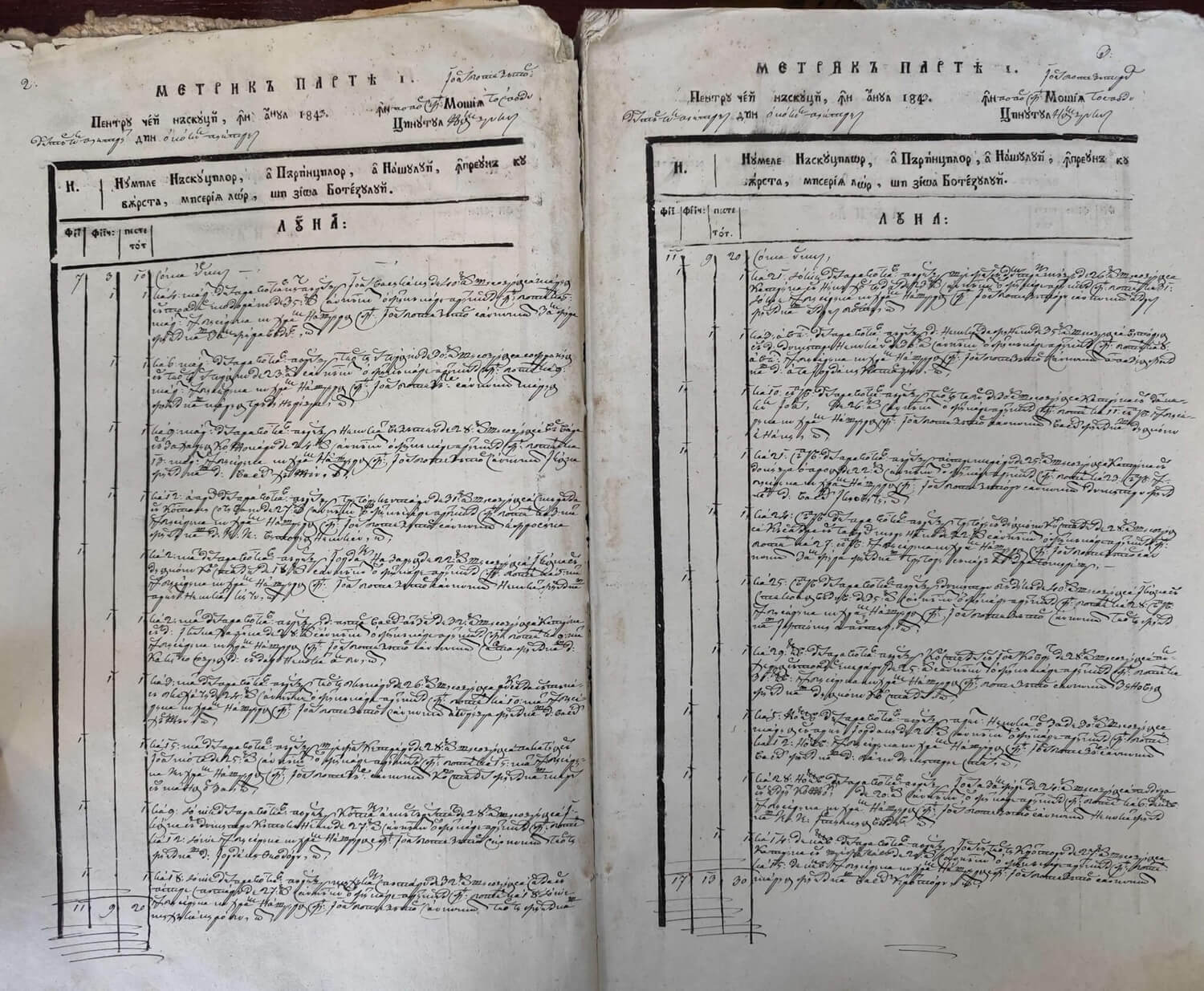
At the base of the project are original historical documents, largely unpublished, written in difficult scripts and hard to access in their raw form. Genealogica plans and pursues the systematic transcription and indexing of the most important archival document collections:
Parish registers for baptized, married and deceased
Created with the purpose of proving "the three most important events of a man's life", parish registers represent perhaps the most valuable documentary source for genealogical research. Time interval depending on denomination and region.
Civil status records for births, marriages and deaths
Starting with December 1865 for Moldova and Wallachia and respectively October 1895 for Transylvania, these secular documents offer a systematic continuation of parish registrations.
Censuses, conscriptions, urbaria and nominal fiscal cadastres
Documents of a fiscal nature, lists of heads of families and inhabitants represent an essential source for the knowledge and nominal documentation of Romania's population before the modern period. Includes the Cadastres of the Treasury of Moldova (1820-1852).
Ledgers, lists and church documents (1800-1900)
Ledgers, lists of parishioners, confessants, marriage certificates and various nominal records compiled by priests — all these documents offer a unique perspective on the lives of our ancestors and can sometimes substitute essential sources (when they are missing).
Agrarian reforms. Peasant land ownership (1864-1945)
Nominal records of land grants from 1864, 1878, 1921 and 1945, these documents represent a valuable resource for researchers interested in tracking and analyzing the economic situation of the time.





The Genealogica project was founded by Andrei Cucuruz in April 2023. Today, the project is coordinated by Andrei Cucuruz and Andrei Jipa.
Genealogica is not an individual project, but a collective effort, built through the contribution of a community passionate about local history, genealogy and documentary research. We want to form a community in which experiences, methods and discoveries can be shared, and errors can be corrected transparently.
The volume of historical documents in archives is immense, and the recovery of this heritage exceeds the capacity of a single team. That's why Genealogica relies on the involvement of volunteers, regardless of their level of experience. Whether you can help with transcribing documents (in Cyrillic or Latin alphabet), indexing names and normalizing data, or want to contribute with your own unpublished resources, your help is essential.
If you are willing to contribute — with resources, on the transcription side (Cyrillic / Latin alphabet), in the correction / normalization process or in any other form – please write to us at contact@genealogica.ro or
Complete a contact form hereA word about rigor and limits
Most transcriptions are made by people who are self-taught in paleographic studies. Even though we consult periodically with experts in the field to ensure that the transcription of documents is carried out respecting the norms used by historians, we do not claim infallibility.
Transcriptions respect, as much as possible, the spelling and structure of the original document, precisely to preserve fidelity to the source and to allow the researcher to work with the information in its authentic form. The responsibility for analysis and conclusions always remains with the researcher.
We urge users to report any kind of problem encountered on the site - any report is treated with the utmost seriousness and corrected as it is identified, in the spirit of an open, honest and perfectible approach.